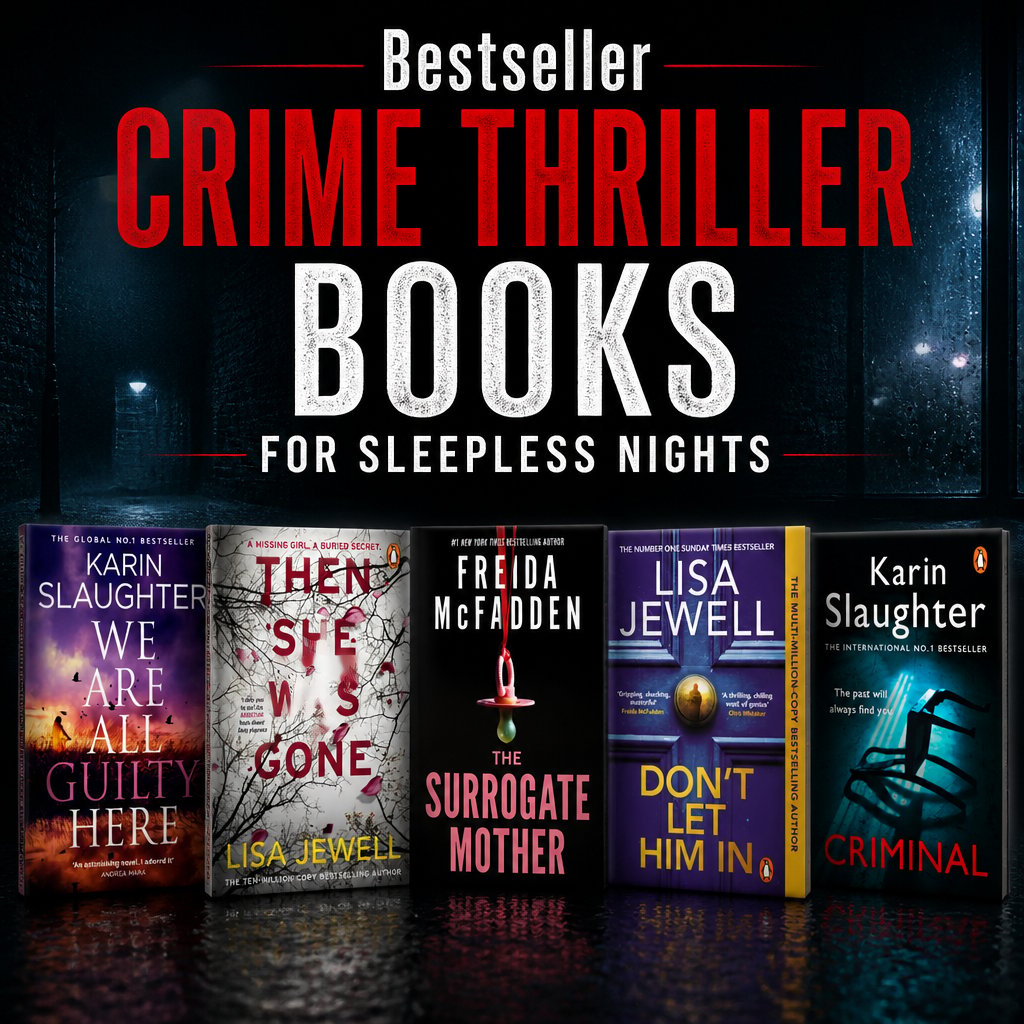
Some crime novels are perfect company for a rainy Sunday. Others follow you upstairs, into the dark, and keep you turning pages long past the point of sense. I have lost more nights than I care to admit to books in the second category, and I have also given up on plenty that promised a shocking twist and delivered something I had guessed by chapter four.
That gap between the promise and the payoff is the real problem with picking a bestselling thriller. The label tells you a book sold well; it tells you nothing about whether you want claustrophobic domestic unease, a slow bloom of family secrets, relationship paranoia that makes you side-eye your own front door, or a gritty investigation with a body count and a badge. Psychological suspense usually lives inside one damaged household and trades on emotional aftermath. Detective fiction spreads wider, with procedure, forensics and a cast you need to keep straight.
Before you buy, check three things: whether the book is a standalone or a series entry that assumes prior knowledge, how large the cast is (multi-narrator thrillers reward attention and punish distracted reading), and how much emotional darkness you actually want, since missing children and predatory men feature heavily in this corner of the genre. Length and format matter too: a 450-page procedural reads very differently on a commute than a 320-page book built from short, snappy chapters. Below are five bestsellers I would genuinely recommend, sorted by the kind of night you are after.
Best for emotional gut-punch and grief-driven suspense: Then She Was Gone
Best for relationship paranoia: Don’t Let Him In
Best for a fast, one-sitting read: The Surrogate Mother
Best for a new detective series: We Are All Guilty Here
Best for darker serial-crime suspense: Criminal
Then She Was Gone

Buy this standalone if you want suspense that hurts as much as it grips, built around a mother who cannot stop grieving a daughter who vanished at fifteen.
Lisa Jewell splits the story between a bereaved family, a decade of unanswered questions, and a new relationship that arrives with unnerving convenience. The tension is domestic and intimate rather than procedural, and the dread creeps in sideways.
What stayed with me is the emotional texture. The grief feels observed rather than performed, and the shift in narrative voices gives the reveals a queasy weight. Readers who like their mysteries opaque until the last page may find they are ahead of it, since Jewell shows her hand fairly early and lets the horror build instead.
Pros
- Genuinely moving portrait of parental grief and long-term loss
- Short chapters and shifting perspectives keep the pages turning
- Works as a first Jewell novel; no series knowledge required
Cons
- The central twist becomes clear well before the ending
- Subject matter involving a missing teenager is distressing in places
- Slower opening act than her more recent thrillers
Don’t Let Him In

Choose this one if you want relationship paranoia: a charming man, several women, and a slow realisation that none of them know the same person.
The structure is deliberately disorientating at first. Jewell moves between households and timelines, and for the opening stretch you are assembling names and connections rather than racing forwards. Stay with it. Once the pattern clicks, the momentum is relentless.
The chapters from the manipulator’s point of view are the standout, chilling precisely because his logic sounds so reasonable. If you have watched documentaries about serial deceivers, the accuracy will unsettle you. The climax is the best thing here, sharp and properly earned.
Pros
- Superb, coldly convincing antagonist voice
- Twisty final third that pays off the slow setup
- Fully standalone, with contemporary, recognisable con-artist detail
Cons
- Large cast makes the first half hard to track
- Multiple viewpoints suit focused reading, not distracted dipping in
- Themes of coercive manipulation may feel too close to home for some
The Surrogate Mother

Pick this if you want a thriller you can finish in two or three sittings, with domestic tension and a twist roughly every thirty pages.
Freida McFadden writes lean, propulsive suspense: small cast, short chapters, plenty of white space. The premise centres on a surrogacy arrangement that curdles, and the claustrophobia builds through household detail rather than police work.
I read it quickly and enjoyed the ride, though I saw the main turn coming before halfway. That is the trade-off with this style. You get an easy, cinematic read with characters you can picture instantly, but seasoned thriller readers who prize misdirection may find the mechanics visible. As holiday or hospital-waiting-room reading, it is hard to beat.
Pros
- Extremely readable; genuinely a one or two-sitting book
- Manageable cast, so nobody gets lost
- Steady drip of reveals rather than one late twist
Cons
- Predictable central turn for experienced genre readers
- Characterisation is functional rather than deep
- Familiar domestic-suspense conventions throughout
We Are All Guilty Here

Start here if you want a proper detective thriller and the pleasure of getting in at book one of a new series.
Karin Slaughter opens her North Falls sequence with two missing girls, a small town where everyone is related to everyone, and a young officer whose family history complicates the case. This is grittier than the domestic titles above: the investigation is methodical, the violence is not sanitised, and the guilt of the title is communal.
The emotional pull comes from the characters, who are drawn with real depth. The first half asks for patience while the town’s web of relationships settles into place. Once it does, the revelations land hard, and the ending sets up book two so effectively that I ordered the sequel the same night.
Pros
- Rich characterisation and convincing small-town atmosphere
- Layered plotting with genuinely surprising later reveals
- Entry point to a new series, so no back catalogue needed
Cons
- Slow, name-heavy first half
- Darker, more graphic content than the psychological picks
- Deliberately unresolved threads left for the follow-up
Criminal (Will Trent, Book 6)

The one to reach for if you want darker serial-crime suspense with real series history behind it, though it lands hardest for readers already invested in Will Trent.
Slaughter runs two timelines: Atlanta in the mid-1970s, where Amanda Wagner is a young officer in a police force that despises women, and the present day, where a student’s disappearance echoes an old case. The period chapters are the heart of the book, furious and precise about institutional misogyny.
Emotionally, this is the most layered entry on the list. Long-running secrets about Will’s past finally surface, which is thrilling if you have read the earlier novels and slightly weightless if you have not. The dual structure also takes a while to gather speed.
Pros
- Excellent historical strand with sharp social detail
- Major payoff for long-term series readers
- Complex, credible characters and tight plotting
Cons
- Best read after the earlier Will Trent books
- Alternating decades can feel disruptive early on
- Contains disturbing violence against women
Buying Guide
Bestseller stickers tell you a book found an audience. They do not tell you whether it fits your mood, your attention span, or your tolerance for grim content. Here is how I choose.
Match the subgenre to your mood
| If you want | Look for | Expect |
|---|---|---|
| Domestic unease and family secrets | Psychological suspense, first-person narrators | Emotional weight, slower burn |
| Relationship paranoia | Multi-viewpoint standalones | Disorientating start, strong finish |
| A tense investigation | Police procedural or detective series | Larger cast, forensic detail |
| Pure speed | Short chapters, 300 to 350 pages | Fast twists, lighter characterisation |
Standalone or series?
Standalones ask nothing of you. Series entries reward loyalty but can feel hollow if you meet the characters mid-arc. Check the listing for “Book X of Y” before buying, and if a book opens a new series, expect some threads to stay open.
Pacing, length and cast size
A 450-page thriller with six narrators needs concentrated reading. A 320-page book built from three-page chapters survives interruptions. Be honest about how you read: on a commute, in bed, or in long weekend stretches.
Content and emotional intensity
Missing children, coercive control and sexual violence are common in this genre. Skim a handful of reader reviews for warnings if certain subjects are difficult for you.
Format
Paperbacks are pleasant to hand around; check dimensions and weight if you travel light. E-book editions often include adjustable text and search features, which help enormously with sprawling casts.
Leave a Reply