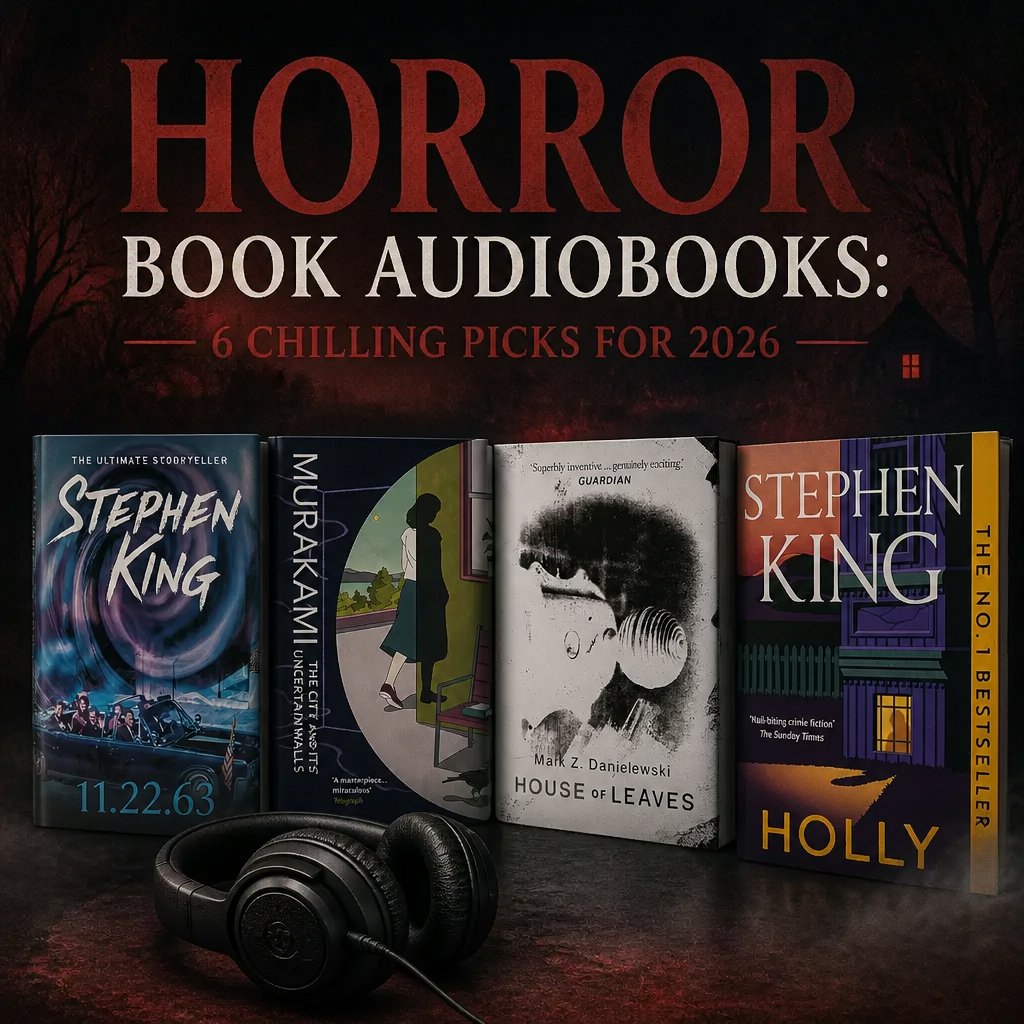
Some of my best scares have arrived through headphones on a dark walk home, when a narrator drops their voice half an octave and the street suddenly feels longer than it did a minute ago. That’s the peculiar magic of horror in audio: you can’t skim ahead, you can’t glance at the last page, and the pacing belongs entirely to somebody else. Fear works differently when it’s whispered directly into your ears.
Horror books audiobooks cover far more ground than most people expect, stretching from progression-fantasy monster tales and infection-outbreak panic to haunted-house dread and vintage occult detection. The trick is matching the subgenre to your listening moment: frantic, plot-forward stories carry a commute beautifully, while slow-burn atmospheric horror rewards a quiet house and a single lamp. Before you commit, think about three practical things: total listening commitment (a 30-hour epic is a relationship, not an evening), scare intensity (some titles unsettle, others genuinely frighten), and whether the structure suits audio at all, since heavily formatted or footnoted books can be tricky to follow without the page.
I’ve listened my way through six very different kinds of fear for this round-up, and each one earns its place for a distinct mood. At The Reading Loft, I sort titles by the feeling they leave behind, and these six span nearly the full emotional range of the genre.
Best for supernatural revenge with real heart: Ask for Andrea
Best for immersive haunted-house dread: House of Leaves
Best for a long commute: The Outsider
Best for dreamlike, quiet unease: The City and Its Uncertain Walls
Best for a full-immersion epic: 11.22.63
Best for a classic detective-meets-monsters mood: Holly
Ask for Andrea

Start here if you want supernatural horror that stays firmly on the victims’ side and moves fast enough for a two-evening binge.
Pros
- Three ghost narrators give the story a genuinely fresh perspective on a serial-killer plot
- Compact 304 pages, so the tension never sags for long
- Dread comes from character and helplessness, not graphic violence
Cons
- The timeline hops between women and years, which takes concentration in audio
- Subject matter (stalking, murder of young women) is bleak from page one
- A few readers find the emotional weight heavier than the thrills
Meghan, Brecia and Skye were all killed by the same man, and they’re now trapped watching him circle his next target. That premise sounds grim, and it is, but the tone is closer to furious solidarity than misery. The three voices bicker, comfort each other, and slowly piece together who he is.
I found the middle stretch the strongest, once the trio starts actively tailing him. The dread here is a slow tightening rather than a jump scare, which makes it a solid pick for anyone who reads psychological domestic thrillers and wants a paranormal edge without nightmares.
House of Leaves

Buy this one in print alongside any audio listening, because the haunted-house horror here lives partly in the layout of the page itself.
Pros
- The Navidson Record sections deliver some of the purest architectural dread in modern horror
- This hardcover edition is beautifully produced, with extra easter-egg pages
- Rereads keep yielding new connections, which is rare in horror
Cons
- 736 pages and 1.31 kg, so it’s a commitment in every sense
- Footnotes, nested narrators and typographic tricks resist straightforward listening
- A minority of readers find the academic apparatus tiresome
A house that is measurably larger inside than out. That’s the whole hook, and Mark Z. Danielewski wrings more terror from a corridor and a tape measure than most novels manage with a monster.
The layered structure (a dead man’s manuscript, an unstable young man’s footnotes) creates a queasy sense that the book is watching you back. Keep a notebook handy. If you love horror that rewards effort, this belongs on the same shelf as dark fantasy and horror anthologies you return to yearly.
The Outsider

This is the audiobook I hand to anyone who wants a police procedural that curdles into something far worse around the halfway mark.
Pros
- Will Patton’s narration carries the small-town paranoia superbly
- Roughly 18 hours 41 minutes, ideal for stretching across a fortnight of commutes
- The impossible-alibi setup is one of King’s cleanest premises
Cons
- Opens with the murder of a child, described in unflinching investigative detail
- The shift from procedural to supernatural loses some readers
- Works best if you’ve met Holly Gibney before
A beloved little-league coach is arrested for a horrific killing, with witnesses and forensics stacked against him. He also has cast-iron proof he was in another city. King builds that contradiction patiently, and the discomfort of watching a community turn on itself is worse than anything with teeth.
Patton’s performance is the reason I recommend the audio over print. He finds a dry, tired register for Ralph Anderson that makes the eventual horror land hard. Pair it with other crime thriller audiobooks if you like your monsters investigated properly.
The City and Its Uncertain Walls

Choose this when you want unease rather than fright: a walled city, a shadow you must surrender, and a quiet that gets under the skin.
Pros
- Dreamlike atmosphere that lingers for days after finishing
- Ties directly to Hard-Boiled Wonderland and the End of the World for longtime Murakami readers
- Gentle, oral-storytelling rhythm suits slow evening listening
Cons
- Deliberately vague, with several threads left unresolved
- Light on the Tokyo texture and food detail some Murakami fans expect
- A poor entry point if you’ve never read him before
The horror here is existential. A young man enters a city he half-invented as a teenager, reads old dreams in a library, and cannot leave without giving up part of himself. Nothing chases him. That’s precisely the problem.
I’d file this under creeping dread, the kind that surfaces at 2am rather than mid-chapter. It’s the most literary pick in this round-up and the one I most often recommend to readers browsing our books shelves for something eerie but not frightening.
11.22.63

Pick this for a 30-hour immersion where the horror comes from history itself pushing back against you.
Pros
- Craig Wasson’s narration gives 1958 Texas a warm, unnerving intimacy
- Contains a memorable overlap with the world of It
- The emotional ending genuinely moved me, which few time-travel stories manage
Cons
- At 30 hours 40 minutes, it demands real commitment
- Long stretches of Lee Harvey Oswald surveillance slow the middle
- Horror fans expecting sustained terror will find it more suspense than scare
Jake Epping steps through a pantry into 1958 with one job: stop the Kennedy assassination. What makes it horror is the way the past resists change, sending obstacles that feel malevolent and personal.
Wasson’s reading is unhurried and specific, and the Derry sequence early on will raise the hair on your neck if you know what happened there. This is my standard recommendation for long journeys, sitting comfortably alongside other audiobooks for road trips that need to survive several hundred miles.
Holly

Reach for this if you want a detective hunting very human monsters, told with the reader always one step ahead of the investigator.
Pros
- Holly Gibney is one of King’s most quietly compelling protagonists
- The villains are horribly plausible, which makes the tension domestic and close
- 448 pages of tight, propulsive plotting
Cons
- The pandemic setting and political commentary divide readers sharply
- You know who the culprits are early, so suspense replaces mystery
- Newcomers miss the accumulated weight of Holly’s earlier appearances
A series of disappearances in a small Midwestern town, an ageing professorial couple, and a private investigator who notices what nobody else does. The horror is the mundane, tidy monstrousness of it: kitchen appliances, careful planning, polite conversation.
I listened to this over three foggy nights and found the dread built precisely because nothing supernatural arrives. If you like sleepless-night procedurals, it pairs neatly with our picks for bestselling crime thrillers.
Buying Guide
Match the subgenre to your listening situation first, then check length and intensity. A commute wants forward momentum; a dark house at midnight wants atmosphere and space.
Work out your scare tolerance
Horror splits roughly into unease, dread and outright terror, and audio amplifies all three. Ghost stories and literary weird fiction sit at the gentler end. Infection outbreaks and demonic possession sit at the sharpest.
| Subgenre | Feels like | Best listening moment |
|---|---|---|
| Haunted house | Slow claustrophobia | Quiet evenings at home |
| Supernatural procedural | Paranoid tension | Daily commutes |
| Literary weird | Dreamy disquiet | Late night, low volume |
| Occult detection | Vintage adventure | Chores and cooking |
| Outbreak/apocalypse | Frantic momentum | Gym sessions, long drives |
| Progression horror | Escalating stakes | Multi-week binges |
Check the length before you commit
Under 10 hours suits a weekend. Ten to 20 hours covers a fortnight of driving. Anything above 25 hours works best as a deliberate project, not background listening.
Consider narration and structure
A single skilled narrator handles shifting timelines and multiple viewpoints far better than a rushed one. Books built on footnotes, unusual typography or heavy formatting lose something in audio, so pick up a physical copy for those.
Think about where you listen
Bone-conduction or open-back headphones let you keep some awareness of your surroundings, which matters on a dark walk. For home listening, a speaker at low volume makes atmospheric horror far more effective than earbuds cranked loud.
If you’re choosing a gift, ask what the recipient rewatches rather than what they read. Someone who loves slow-burn ghost films will want atmosphere; someone who rewatches zombie thrillers wants pace, and our gifts selection has bookmarks and candles that suit either.